· By APEX
ChatGPT vs Personal Trainer: What a 2026 Study Found
Wonder whether an AI can perform better than a personal trainer? This study showed that ChatGPT performed better on certain tasks. Here's what it found...
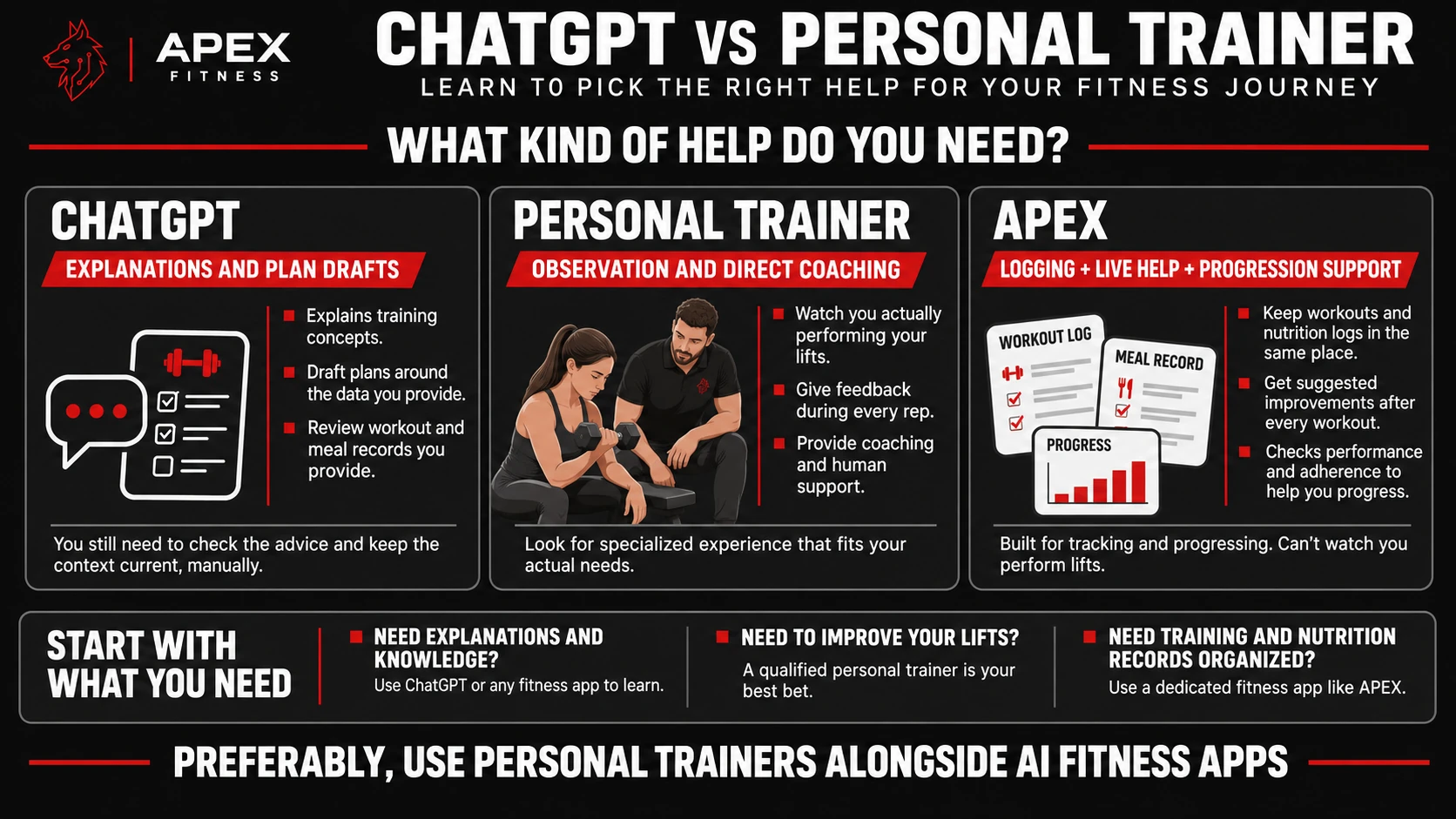
Let's put it in simple words:
ChatGPT knows more, at probably much higher accuracy, and with less likelihood of general knowledge error. As long as you're giving it genuinely true data before asking for help, an AI will outperform personal trainers. But it lacks real-life context.
A personal trainer will be more likely to find out when you're lying or making mistakes that an AI would dismiss. A PT can also help you perform exercises better by being in the gym with you (or even through video chat). And even more important, a trainer can gather way more context by knowing how you look and perform in real life than ChatGPT from your questions and demands.
Choosing between AI and a personal trainer comes down to three questions:
-
Can you perform your exercises confidently and judge how hard you're working without someone guiding or pushing you?
-
Can you follow your nutrition plan without frequent guidance or check-ins?
-
Are your workout and meal logs as accurate as you can make them?
If your answer to these three questions is YES, then you probably don't need a personal trainer anymore. An AI would be an excellent choice to help you track and get insights from your workouts and meals.
But even if only one of your answers is NO, then you should definitely keep using an AI but consider hiring a personal trainer to guide you through everything that ChatGPT or any other AI can't do.
Here's more about the study above so you can draw your own conclusions:
Is ChatGPT a good personal trainer? What the study tested
It didn't test results of ChatGPT vs trainers directly. Instead, it tested the performance in scientific correctness, usefulness and clarity between ChatGPT, eighteen trainers and nine sports science experts.
In the tests, the higher overall scores came from ChatGPT. In all nine questions asked, the trainers only not performed better in three of them. GPT-3.5 at the time, performed better at the other six.
Of course, this is a knowledge test. It doesn't establish whether following ChatGPT's advice leads to better training results.
More importantly, it didn't test something essential: ChatGPT and other AIs are reactive tools. They mostly give you guidance and help when you ask them. If you don't, you're mostly left on your own...
AI vs personal trainer: what are you paying for?
This is what matters most when picking between an AI and an actual personal trainer.
What makes a personal trainer worth paying for?
Their attention can change how you train, plan your workouts, and organize your meals.
Their focus is to make you do things BETTER. They draw on both their knowledge and their practical coaching experience.
They might teach an unfamiliar lift, show you where to place your feet, or explain how to position your torso and control the movement. That's the value of personal training.
They also help you ACTUALLY follow the plan. With in-person sessions, you have someone beside you throughout the workout to help you follow through.
So, how do you know a personal trainer is actually worth it? A prospective trainer should answer these four questions positively:
-
Will they watch you perform exercises and explain why or how to perform each exercise properly, according to goals and personal needs?
-
Will they help you record your progress and keep track of what goes well, what changes, what goes wrong, and explain how to improve going forward?
-
Will they help you follow your workout and nutrition plans, including when you miss sessions or struggle with meals?
-
Will they help you make progress by consistently improving your plans based on performance and adherence?
If they answer YES to these four questions, then you're getting your money's worth.
Now, this doesn't mean personal trainers will only use their knowledge and experience to help you. They're also allowed to use AI to prepare ideas or simply find solutions to problems they may not know how to solve.
But they still need to go through the nitty-gritty:
-
Knowing how to actually coach people into changing their fitness by keeping them accountable and disciplined.
-
Giving practical instructions, guidance and recommendations in both training and nutrition.
-
Being physically at the gym to help people through every workout routine and exercise.
-
Offering advice regarding habits and general lifestyle changes that AIs would miss.
Without these, there's no reason to use a personal trainer. You would do a better job by yourself and with ChatGPT or Claude for fitness. Or if you can find a better personal trainer, then that's even better.
However, you should also think about whether YOU actually need one...
When should you consider getting a personal trainer?
There are several situations in which a personal trainer is a MUST-HAVE. It could be alone or with the help of an AI app like APEX. In any case, personal trainers will help you in specific situations where an app can't:
- If you're unsure how to perform exercises:
This is the highest-ROI benefit from hiring a personal trainer. They can demonstrate a movement LIVE, while watching how you perform it and correct you in the process.
Even if you watch videos on how to perform exercises and learn all the cues possible, there's still a chance you won't learn how to do a particular lift properly.
Here's where even just a few sessions with an actual personal trainer can be useful.
- If you struggle with discipline and self-motivation:
Some people have a hard time getting off their couch or just making time in their schedules to go to the gym. If you're one of these people who can't simply build the desire or willingness to do it by themselves, it's not a bad idea to get a personal trainer.
PTs are not only instruction-givers, they also coach you into doing what you have to do. And this does not only fall into pushing you to go to the gym or eating the right things, it's also about avoiding what could reverse or stop your progress.
More importantly, having booked sessions with a PT that you pay for will make it more likely you will attend. Who wants to lose money, right?
- Maximizing results or pursuing a specific goal:
This is where it gets even better. ChatGPT can help you with suggestions for what to do. But it will be a lot harder for the AI to know exactly what you need to maximize your results or reach a specific fitness goal.
That's where an experienced personal trainer enters. A trainer with specific knowledge (bodybuilding, fat loss, running, etc.) will have way more practical advice about what to do and how than ChatGPT or Claude or any other AI will have.
A coach with relevant experience can help turn a specific goal into a practical training plan. ChatGPT may help at a surface level, but it will likely not have the objective feedback that a personal trainer can give.
What about the price?
Now, this is the only part where a personal trainer is less efficient than an actual subscription to ChatGPT or a fitness app like APEX.
While ChatGPT has a free plan and some cheap subscriptions, a trainer's price usually depends on their experience, your actual goals, and location.
An average personal trainer can easily cost $50-75 per session. That's about $200-300 per week if you're training four times. This can ramp up towards $800-1,200 a month with ease.
A fitness app or ChatGPT subscription usually stays within $20. APEX, however, costs $6.99 a month.
The difference though, is that a personal trainer will be beside you and guide you through almost every rep. ChatGPT won't.
VERDICT:
If you're a beginner, someone who struggles with motivation/discipline/structure, or simply want to achieve a very specific goal that requires tons of specialized knowledge and advice, then go for a personal trainer.
Otherwise, if you have some experience, know how to perform exercises properly and don't have any specific goal that requires specialized practical knowledge, then use an AI app.
Can ChatGPT be my personal trainer between workouts?
Yes, to a point.
ChatGPT or a standalone AI fitness app can help review your training if it has the relevant records. Most AI apps support files and images so you don't have to type your entire routine or nutrition plan for it to know what to recommend.
Between workouts, this can be the perfect help to analyze your performance and adherence. And in case you already have a personal trainer, ChatGPT or an AI fitness app can be an excellent tool to analyze your meals or figure out how to do progressive overload according to your performance.
ChatGPT vs personal trainer vs APEX
If you find it awkward to track workouts and follow advice inside a chat, APEX brings those tasks together in a fitness app.
With a specialized fitness AI app like APEX, you can keep track of everything (completed sets and their difficulty, meals with specific macros, and your general readiness before a workout). APEX then uses those records to suggest changes as you go. This includes consistent progressive overload recommendations that you can review and accept (or reject).
More importantly, APEX helps you adapt your nutrition plan to your actual performance. It starts with your workout plan, then uses your logged workouts and meals to assess your performance and how closely you're following the plan.
With APEX, workout and nutrition records live together. And you get weekly or biweekly check-ins that analyze your performance as you go, so you can see the results of your hard work on your body as it happens.
Here's a comparison table to consider:
| What you need | ChatGPT | A personal trainer | APEX |
|---|---|---|---|
| Exercise explanations + starting workout and nutrition plans | Can draft plans from whatever context you provide. Without enough detail in your prompt, its guidance may be too general. | A trainer will analyze your lifts directly, ask the right questions, find out from your responses what to do or avoid, and then give you guidance accordingly. | Has 3D video explanations with instructions for every exercise. It also generates workout and nutrition plans, routines on-demand, and meal recommendations. |
| Someone watching your lifting technique | You can upload images/video for the AI to analyze. But the advice will be limited to what it can see, and the accuracy will likely not be high. | An in-person trainer can observe, analyze, and guide through every rep. | APEX's exercise instructions are available and will be adapted to your actual performance, with guidance on whether to keep going, add or remove weight as you perform a workout. No current form analysis. |
| Progress and changes based on performance | It will base all its changes on what you provide. If data is wrong, it will usually take it as is. | They will know exactly where you're lagging, how you can improve, and give you advice on how to move forward based on what they see. | Logged exercises, sets and difficulty ratings, as well as what you actually eat (if logged), will feed suggestions you can review. |
| Help being disciplined and following through | You can schedule tasks that help as reminders or nudges to keep you disciplined and motivated. | Booked sessions, direct chats, and consistent check-ins will make it harder to skip the gym or make mistakes. | Workout reminders, weekly progress check-ins, progressive overload improvements, and a live chatbot that has your actual logged data put reminders and training records in the same app to help you follow through. |
| Cost | You can use the free plan, risking stalled knowledge and ideas (free versions use older models). Paid plans have fewer limits and more updated, often accurate models. | A trainer can cost a lot of money, but their more accurate and objective, practical knowledge will be unmatched. | Logging workouts and meals manually + your first workout and nutrition plans are totally free. Premium costs $6.99 a month or $59.99 a year, for progressive overload help, meal recommendations, and a pocket personal trainer that's always there for you. |
Want to know how ChatGPT compares with a fitness app like APEX?


ChatGPT vs personal trainer FAQs
Did ChatGPT really beat personal trainers in a study?
Yes, on general fitness knowledge. The test, however, didn't prove that this knowledge's accuracy was better at producing results than the personal trainer's. That's a different study not yet done.
Can ChatGPT correct my lifting form?
Yes, but only to a point. ChatGPT, Claude and some fitness apps are already good enough to check your form, but unreliably. You'll have to upload videos and images for them to analyze them. Yet, their accuracy may be limited. A personal trainer just needs to be by your side and will have way better, more accurate and practical knowledge to actually help you perform lifts well.
How much does a personal trainer cost compared with AI?
A personal trainer can cost $500 to $1,000 a month. ChatGPT and other AI apps can cost as little as $7-10/month. Be aware though, neither ChatGPT nor any app can replace a good personal trainer.
Can AI replace a personal trainer?
No. AI can cover most of the knowledge: reasons to choose specific exercises, creating workout plans, generating nutrition plans and meal recommendations, etc. But a personal trainer, who's supervising workouts directly and in real life will have more specialized and objective guidance.
Can ChatGPT write a workout program?
Yes. ChatGPT or any fitness app can write workout programs and plans. APEX, for example, will generate your workout plan alongside a routine. Then it will help you create a nutrition plan that fits your expected training volume.
Sources
- D'hoe, Kirk, Boone, and Colosio. ChatGPT Outperforms Personal Trainers in Answering Common Exercise Training Questions. Journal of Sports Science and Medicine, 2026.
- OpenAI. Use ChatGPT: projects, files, images, and connected tools.
- OpenAI. Scheduled tasks.
- OpenAI. Pricing and plan availability.
- Anthropic. How to create and manage projects in Claude.
APEX publishes this comparison and sells the app described here. APEX is not affiliated with OpenAI or Anthropic.