· By APEX
What to Eat After a Workout: Meals for Muscle Gain and Fat Loss
Don't know what to eat after a workout? APEX helps you choose. Here are several options a quick guide on what to take into account.
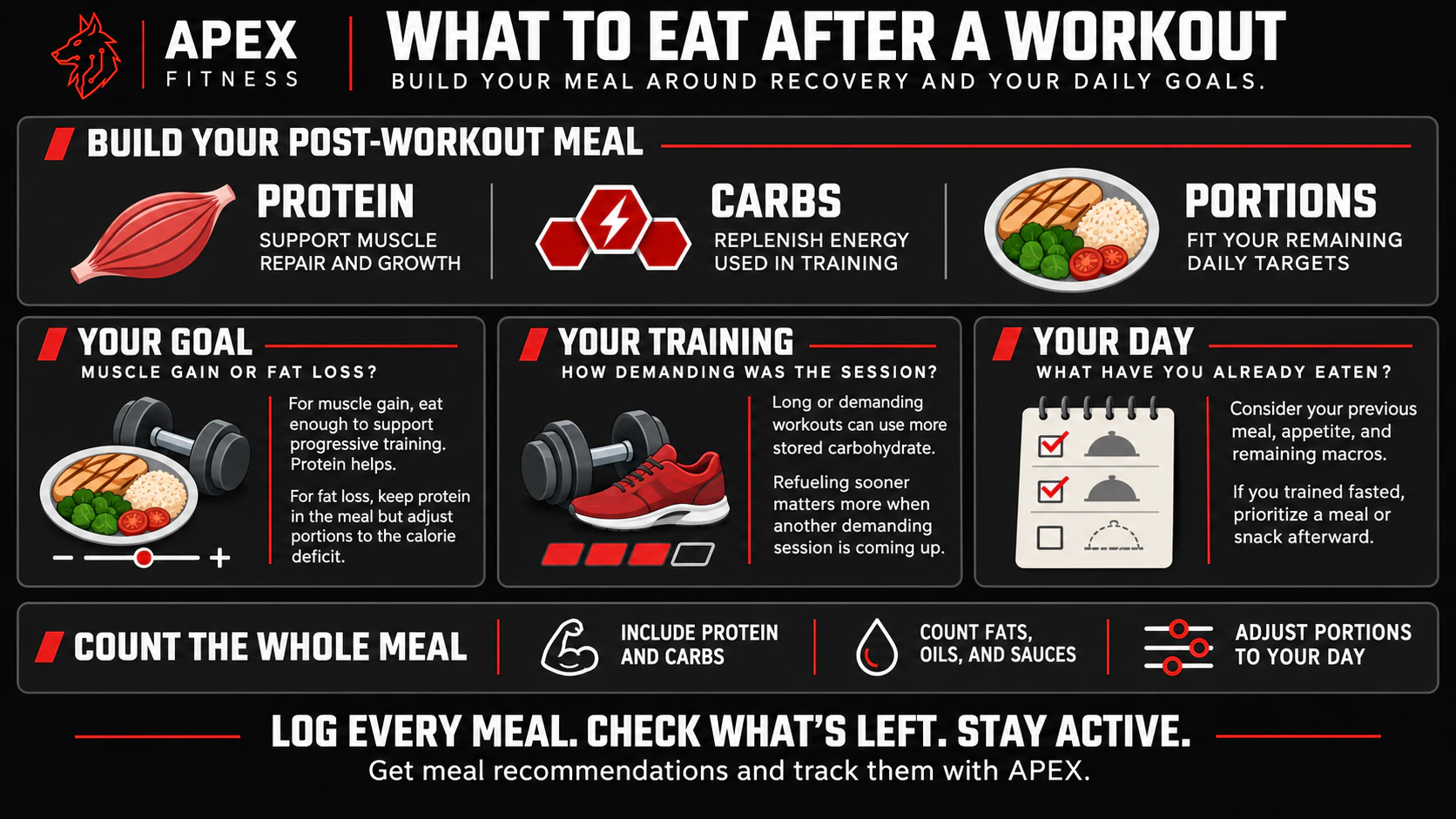
Let's start with the fundamentals.
You need three things after a workout:
-
Protein: this is what your body uses to build muscle. How much protein you need depends on your size, training, and calorie intake. Eat insufficient protein and you'll be leaving tons of gains behind. Don't focus on eating all your protein after working out, but just a bit within a few hours of training so you can help the building process.
-
Carbs: replenish your energy. You will use some of your glycogen stores if you're training hard enough (especially if you're adding cardio). Without enough carbs, replenishing that glycogen can take longer, especially if you're training again soon. Just eat enough so you can recover well after hard workouts but don't eat all your carbs at once.
-
Fats: these matter less after a workout. You can eat some to replenish some energy but they don't have the same immediate role as protein or carbs. Avoiding fats is not okay either, just add enough so they add up to your daily targets.
In short, you should focus on eating enough protein to boost your growth if you're doing resistance training. And sufficient carbs to replenish the energy you've spent (especially if you did cardio). For fats, just make sure they don't go past your daily numbers.
1. Classic chicken, rice, and broccoli
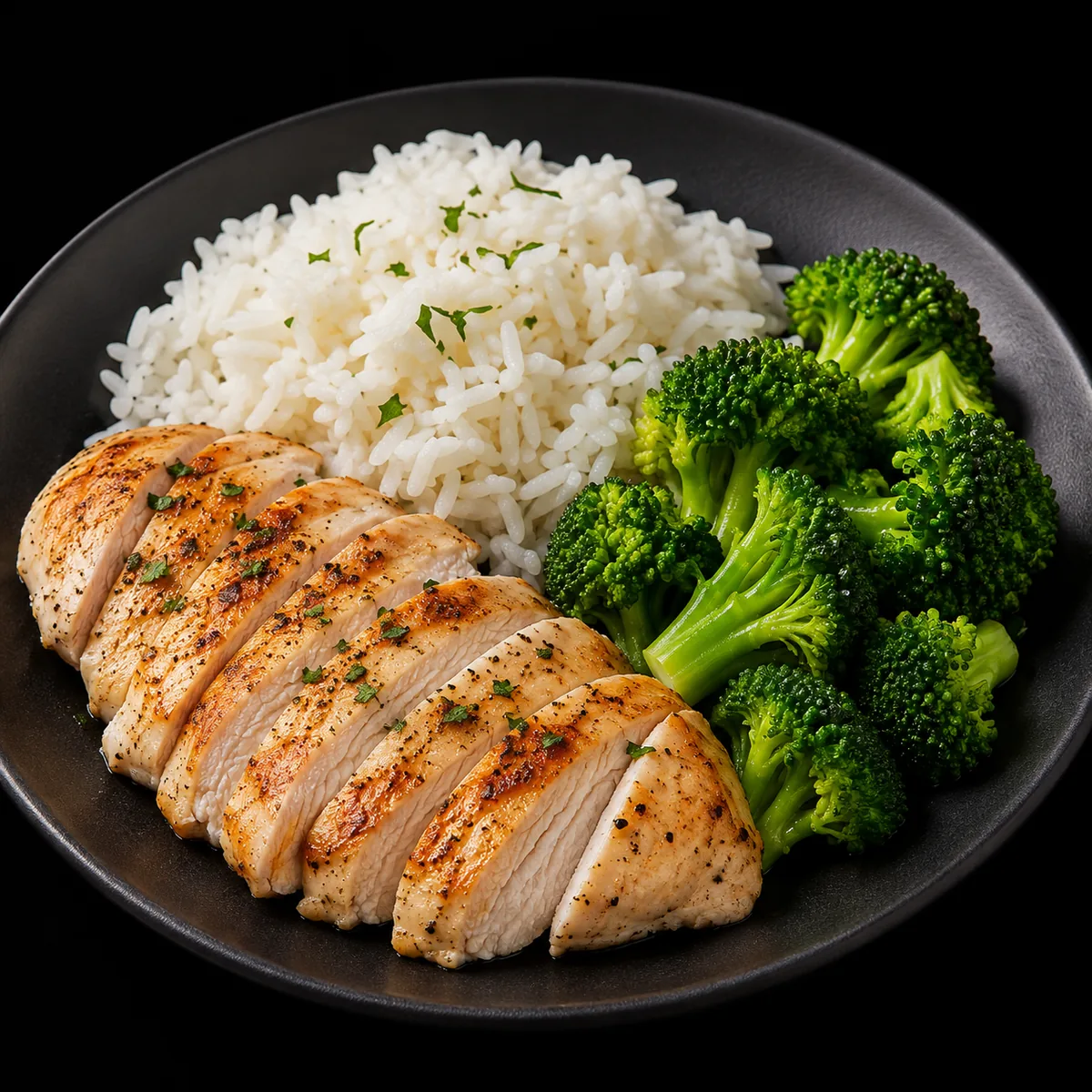
Simple and easy to batch cook. You can adjust it to your needs without hassle and still tastes great with the right seasoning.
Cooking time: 5-10min (if chicken already prepared)
- Total calories: 410-485kcal
- Protein: 40-47g
- Carbs: 49-59g
- Fats: 5-6g (without added oil or butter)
Ingredients:
- 110-125g (3.9-4.4oz) cooked skinless chicken breast
- 150-180g (5.3-6.3oz or about 3/4-1 cup) cooked white rice
- 100-120g broccoli (3.5-4.2oz, about 1 cup chopped) weighed raw
ALTERNATIVE: If you're vegan or vegetarian, replace the chicken with 200-250g of high-protein, extra-firm tofu. Depending on the brand, the meal will contain roughly 500-650kcal, 30-50g protein, and considerably more fat.
2. Tasty greek yogurt with oats and banana (and/or berries)
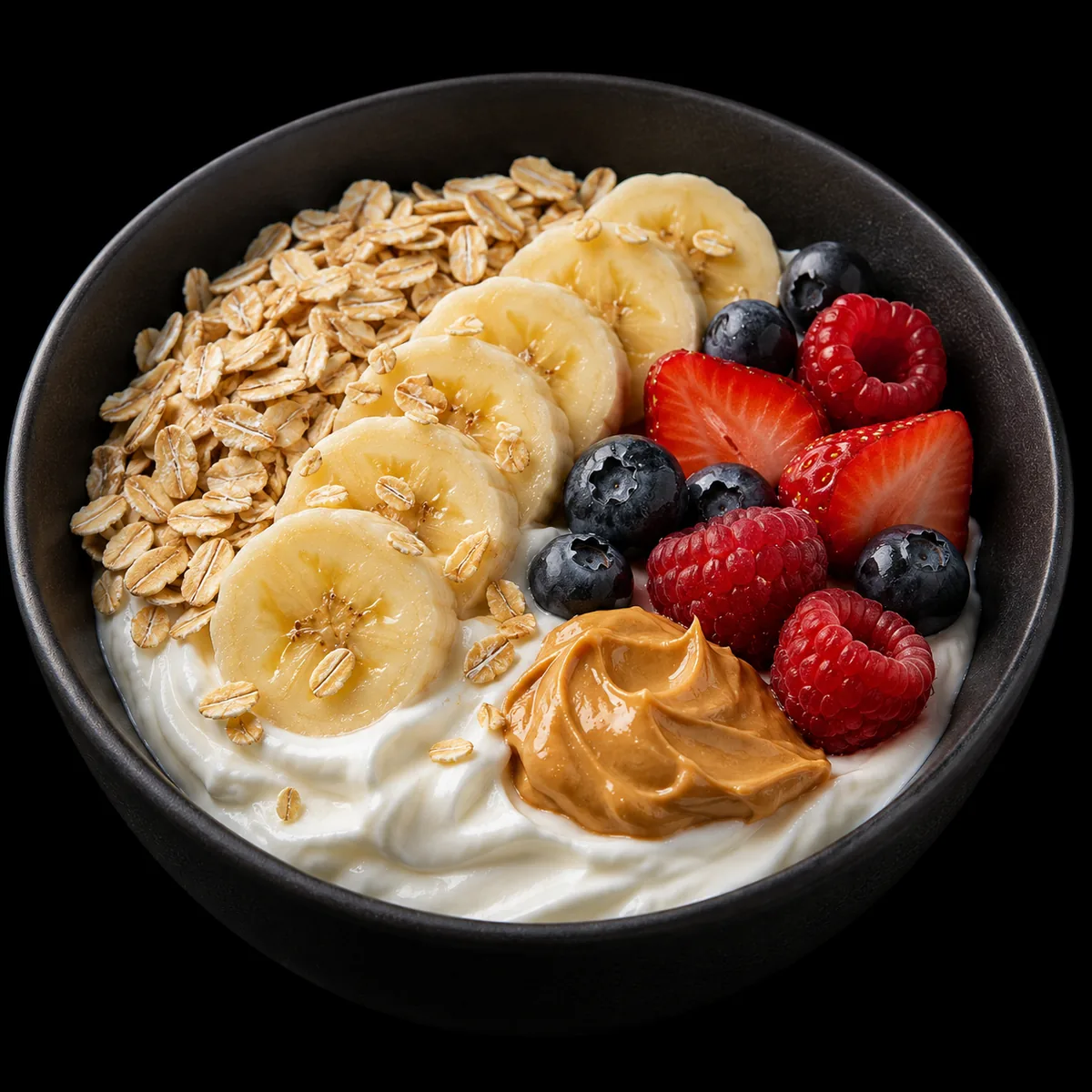
An excellent choice for saving time. Just mix the oats into the yogurt, and cut the banana on top. Add berries for extra antioxidants and flavor. A spoon of peanut butter (optional) may help to add fats and a bit of protein.
Cooking time: 2-5min
- Total calories: 440-480kcal (up to 570kcal with peanut butter)
- Protein: 34-36g (up to 40g with peanut butter)
- Carbs: 69-76g (up to 79g with peanut butter)
- Fats: 4-5g (up to 13g with peanut butter)
Ingredients:
- 250g (8.8oz or about 1 cup) plain non-fat Greek yogurt
- 40-50g (1.4-1.8oz or 1/2-2/3 cup) dry oats
- 1 medium banana
- 50g (1.8oz) berries
- 15g (0.5oz or about 1 tablespoon) peanut butter (optional)
HOW TO: Pour the yogurt into a bowl, then add the oats, slices of banana and berries. Peanut butter on top if you want.
IMPORTANT: If you're lactose-intolerant, feel free to use lactose-free Greek yogurt. Protein, calories and fat should be similar if you choose a comparable product, but check the label.
3. Breakfast style eggs, toast, and fruit:
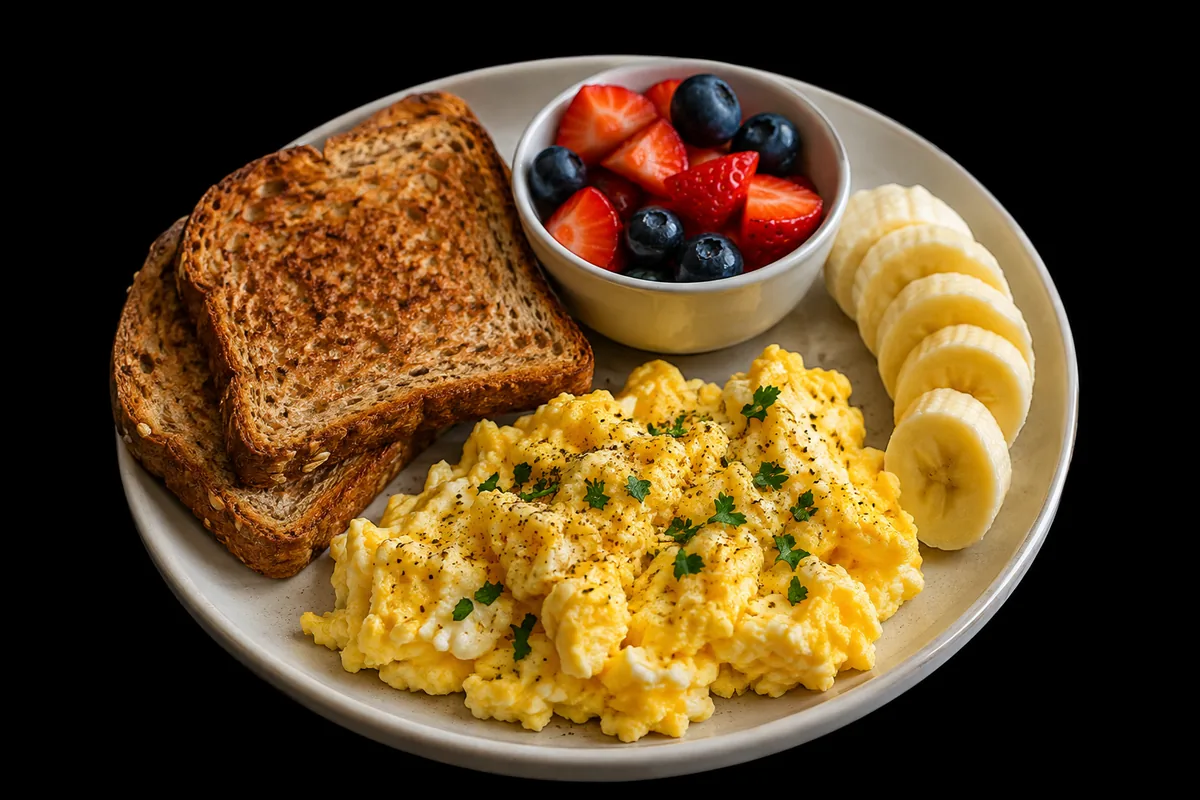
Pretty straightforward, saves you time and fills you up with enough volume. And of course, it's still healthy despite all the bread deniers.
Cooking time: 5-10min
- Total calories: 500-580kcal
- Protein: 39-41g
- Carbs: 59-75g
- Fats: 13-15g
Ingredients:
- 2 large whole eggs
- 150g (5.3oz) egg whites
- 2 slices of whole-wheat bread (70-80g or 2.5-2.8oz total)
- 1 medium banana
- 100g (3.5oz) berries (optional)
HOW TO: Preferably scrambled so it's faster to cook. Just place everything on a dish separately. No need to overthink it.
IMPORTANT: If you want to reduce fats significantly, remove or reduce the number of yolks from the eggs. Replacing the 2 whole eggs with another 150g of egg whites will bring the meal to roughly 440-520kcal, with 3-5g of fat.
4. Tuna sandwich with crunchy veggies:
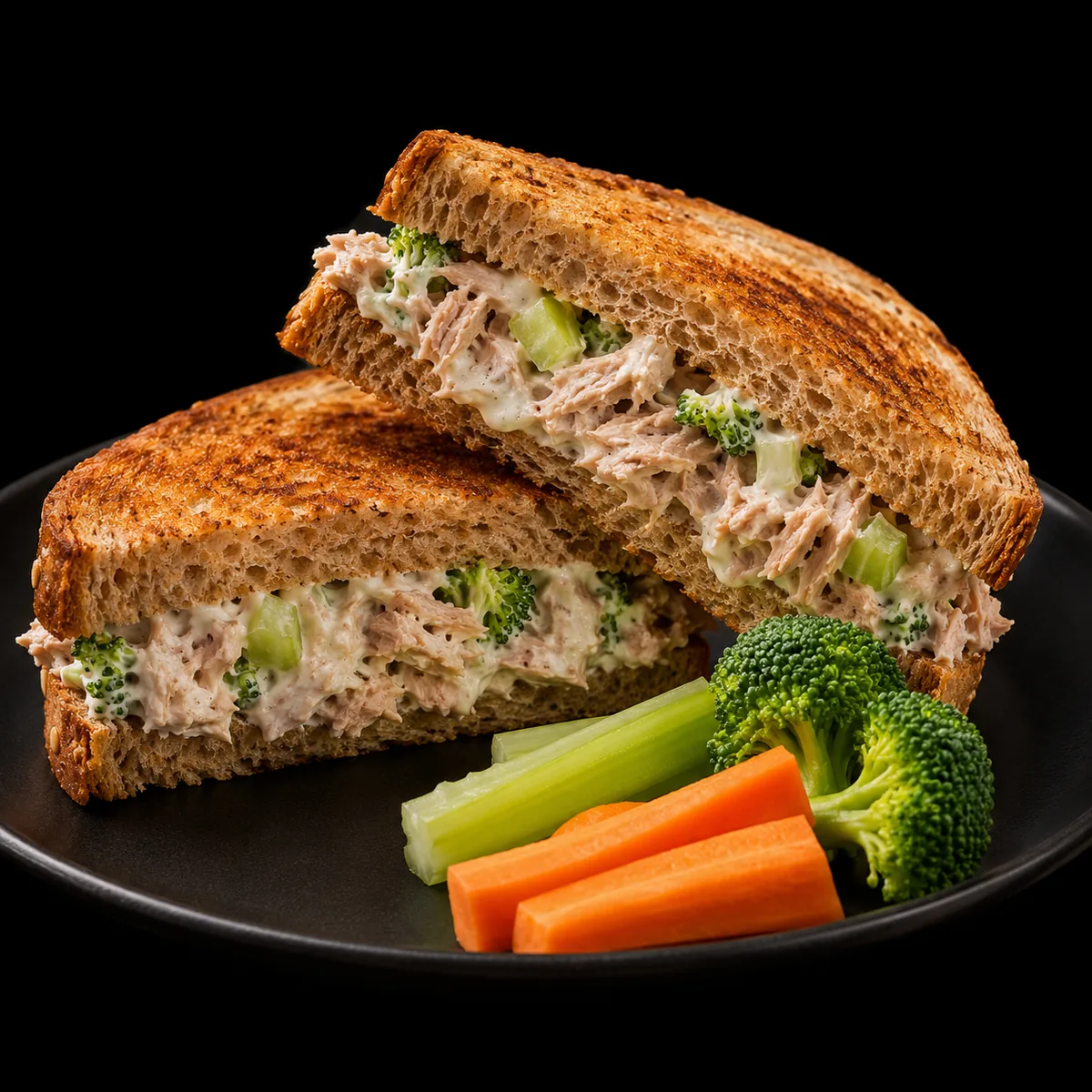
Enough protein and sufficient carbs in a very practical meal. It's portable and pretty cheap.
Cooking time: 2-5min
- Total calories: 300-430kcal
- Protein: 35-55g (depends on the tuna brand and portion)
- Carbs: 32-43g
- Fats: 3-6g
Ingredients:
- 120-140g (4.2-5oz) canned tuna in water, drained (about 1-2 cans, depending on size)
- 2 slices of whole-wheat bread (70-80g or 2.5-2.8oz total)
- 30g (1oz) non-fat Greek yogurt
- 50-100g (1.8-3.5oz) broccoli or celery
HOW TO: Preferably mix the yogurt with the tuna to add flavor and softness (easier to spread). Add salt and pepper to liking.
5. Fruit and protein smoothie
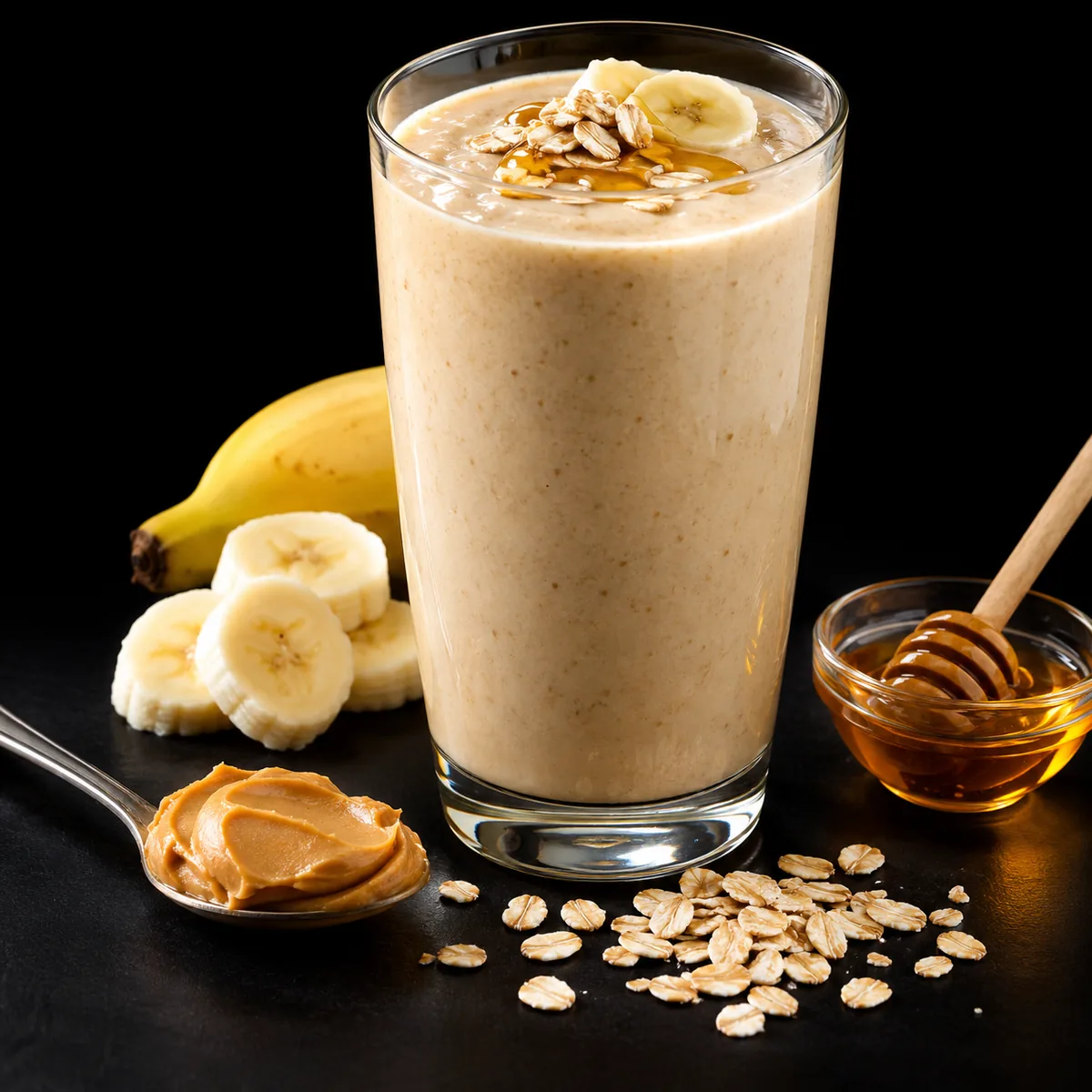
Nothing comes close in terms of convenience. Preferably drink it just after blending the ingredients. It can be pretty tasty and quick to consume.
Cooking time: 2-5min
- Total calories: 390-575kcal (depends on dairy choice and optional extras)
- Protein: 35-55g
- Carbs: 50-72g
- Fats: 3-11g
Ingredients:
- 1 scoop (30g or 1oz) whey protein powder (about 24g protein per scoop)
- 200g (7oz) plain non-fat Greek yogurt or 200ml (6.8fl oz) low-fat milk
- 20-35g (0.7-1.2oz) dry oats
- 1 medium banana
- 10g (0.35oz) peanut butter and/or 10g (0.35oz) honey for flavor (optional)
HOW TO: Pour everything into a blender. Then blend until consistency is smooth. Add honey for sweetening and extra flavor.
IMPORTANT: Calories can vary considerably depending on how much milk/yogurt and extras you add. For reference, 10g of peanut butter adds approximately 60kcal and 5g of fat, while 10g of honey adds around 30kcal and 8g of carbs.
For any of these meals, remember to log them in APEX. Remember to consider oils, sauces, butter, and any other high-calorie add-ons for accuracy.
How to eat for muscle gain vs fat loss
This starts in the planning. Your goal will tell whether you choose one or the other.
Here's how it goes:
Post-workout meals for losing fat:
Fat loss requires a sustained calorie deficit. That's why the best meals will have FEWER quantities of high-calorie ingredients (or at least fit within your calorie targets). Remember to reduce fatty add-ons over carbs or protein. For this, you should first know what your maintenance calories are (find out in our calorie calculator) so you can plan meals accordingly.
Post-workout meals for building muscle:
Here, you should focus on eating slightly above maintenance (although it depends on your specific goal). Protein becomes the most important of your meals when you're in search of more lean mass. While enough protein helps build muscle, it's not necessary to eat all of it just after a workout. Just make sure to get closer to your daily goals. Feel free to check our macro calculator to find out how much you should eat.
In either case, for any of these we recommend going through our should I bulk or cut guide and tool. It will guide you through which type of meals you will benefit the most from can help.
How to eat post-workout to meet targets
Say your maintenance target is 2,200 calories, with 150g protein, 265g carbs, and 60g fat. Just an example, not a target for everyone.
Here are some post-workout meal situations to consider:
First or second meal (breakfast or lunch)
If you're training in the morning, given it will be your first or second meal and you need to boost the rest of your day, you can go higher in calories if it fits your daily target.
That is, a post-workout meal around 500kcal may work for you. It may feel too heavy if you eat a lot at once, but it can help you replenish energy afterward and recover from hard training.
This could include around 40g protein and 50g carbs, which add up to 360kcal before fats and extras. If you're tracking with APEX, check how much you have left for the rest of your meals during the day to reach your target.
GREAT OPTIONS: Eggs with toast and fruit / Greek yogurt bowl with fruits or similar
Third or fourth meal (lunch, afternoon meal, dinner)
If it's not your first meal, and you have logged some calories already, feel free to adjust the macros and calories for each of these meals to what you have left.
A good post-workout meal in the afternoon or night doesn't need to be so high in calories. It just needs to help you replenish, depending on how much you have already eaten during the rest of the day.
If you've logged 1,500kcal already, you have 700kcal left in this example. If you're above 2,000kcal, you have less than 200kcal left. That depends on what you ate, not the time of day.
If bigger meals bother your stomach or sleep, keep the meal lighter (especially close to bedtime). You'd want to make sure it doesn't affect your sleep.
Either case, focus on reaching your targets (mainly protein and carbs). Keep it light with fats at night if they bother your digestion, but there's no need to avoid them just because it's late.
GREAT OPTIONS: Chicken, rice and broccoli / Tuna sandwich with veggies or similar
For convenience
For times where you just need to maximize protein and carbs due to time restraints or general convenience, you should probably consider a fruit and protein smoothie instead.
If you're short of protein, add another scoop of protein powder to double the amount from the powder, not the whole smoothie. More oats and fruits can help you reach up your carbohydrate targets.
Snacks and "cheat foods"
We usually recommend eating these after your post-workout meals and before your next meals.
If you're training hard enough, you may get hungrier before your next meal. This doesn't necessarily mean your glycogen is still depleted.
For these times, we usually recommend eating a high-protein snack, preferably something below 200-300 calories. How much fat it contains matters if you're running out of room in your daily target.
Good choices include protein bars and protein shakes. Although nuts may also help if you keep portions small.
NOTE: These are estimates and depend on your personal preferences and needs. We just give general recommendations that can help most people.
How to calculate macros from your meals
This is probably the most annoying part of taking your nutrition seriously, especially for post-workout meals.
Luckily, APEX makes it a piece of cake.
The best way to reach your daily targets for macros is to LOG EVERYTHING, as soon as or before you eat it. That makes calculating a lot quicker and accurately.
APEX can help you even further.
Its photo-analysis feature helps you estimate total amounts more easily (if you don't know them), or simply estimate overall macros and calories (but it may miss portions, oils, or hidden ingredients). Simply take a photo, add a description (to help it analyze more accurately), and let it do its job.
Then just review the details and confirm. This will save you tons of time.
If you prefer to do it manually after counting all ingredients, that's also doable. All basic and commercial foods in APEX's library come from official governmental databases. Some of them are estimates, based on ingredients (for custom or national foods).
Either way, APEX makes it a piece of cake to reach your targets. Try it.


How soon do you need to eat after training?
There's no single time to follow for everyone. Eating protein before or after training can both work. But true enough, you should consider eating enough after training so you can support muscle protein synthesis.
According to studies, protein synthesis can already be elevated within a few hours after training. How soon you need to eat depends partly on what you ate before, but given you've just trained hard, it's a logical idea to eat enough anyway.
This is even more important if we consider carbs. You probably don't need to eat 100g of protein after training to build muscle. But how many carbs you need to refuel and recover glycogen depends on how much you trained and when you train again, not a fixed 100g.
Having said all that, here are a few situations that may help you choose:
| Your situation | *What to do * |
|---|---|
| You ate a protein-rich meal before training. | No need to squeeze as much protein after your workout. However, try to replete your carbs. |
| You trained while fasted and/or didn't eat anything for over 6hrs before training | Here's when eating protein sooner matters more. Your body has used energy to fuel your workout, mainly from carbs and fats. Include protein alongside enough carbs. |
| Just finished a workout but need to train again within 2-4hrs | Focus on replenishing your carbs and fluids. Liquids can help. Include protein too, with portions you can digest comfortably. |
At the end of the day, the meals before your workout affect how soon you need to eat afterward. If you're eating enough before training, you should still eat but no need to worry about optimizing it.
How much protein, carbs, and fat should the meal have?
Once again, it depends on what you ate before. But more importantly, it depends on your nutrition plan and goal.
-
For protein: Most people will benefit from meals with 20 to 40g of protein. This is enough to stimulate muscle protein synthesis (MPS) after exercise. This is not universal, but a general rule that can help. With that in mind, there's evidence 40g of whey stimulates more MPS than 20g after whole-body training. That study measured a few hours of MPS, not long-term muscle growth.
-
For carbs: Here, the ideal amount depends on how hard you worked out. Long or intense training sessions, especially with cardio, can use more glycogen, so they may require more carbs to replenish it. Shorter, less intense workouts may not need as many carbs. And if you're training again soon (within 4-6hrs of your last workout), then you should focus on eating rapid-absorption carbs (like honey, white rice, white bread, low-fiber fruits, gummies, etc.) instead of slow-absorption ones (whole-wheat items, etc.). For most training days, just try to match the carbs to the amount of work you did and what you have left in your daily target.
-
For fats: Fats usually don't matter as much. There's no need to add or take away as long as you're meeting your daily fat target. You may already get enough fat if you're eating complete meals (eggs and meats contain some, but check your daily totals).
IMPORTANT: It's not only the food you eat but your liquid intake that matters after a workout. Especially after long sessions with cardio included, you may need more fluids to replace what you lost through sweat (this differs between people and conditions, so drink to thirst and account for sweat losses rather than forcing a fixed amount).
How to use APEX to figure out what to eat after workout
APEX will help you in multiple ways. The most helpful is the meal recommendation prompt on its chatbot.
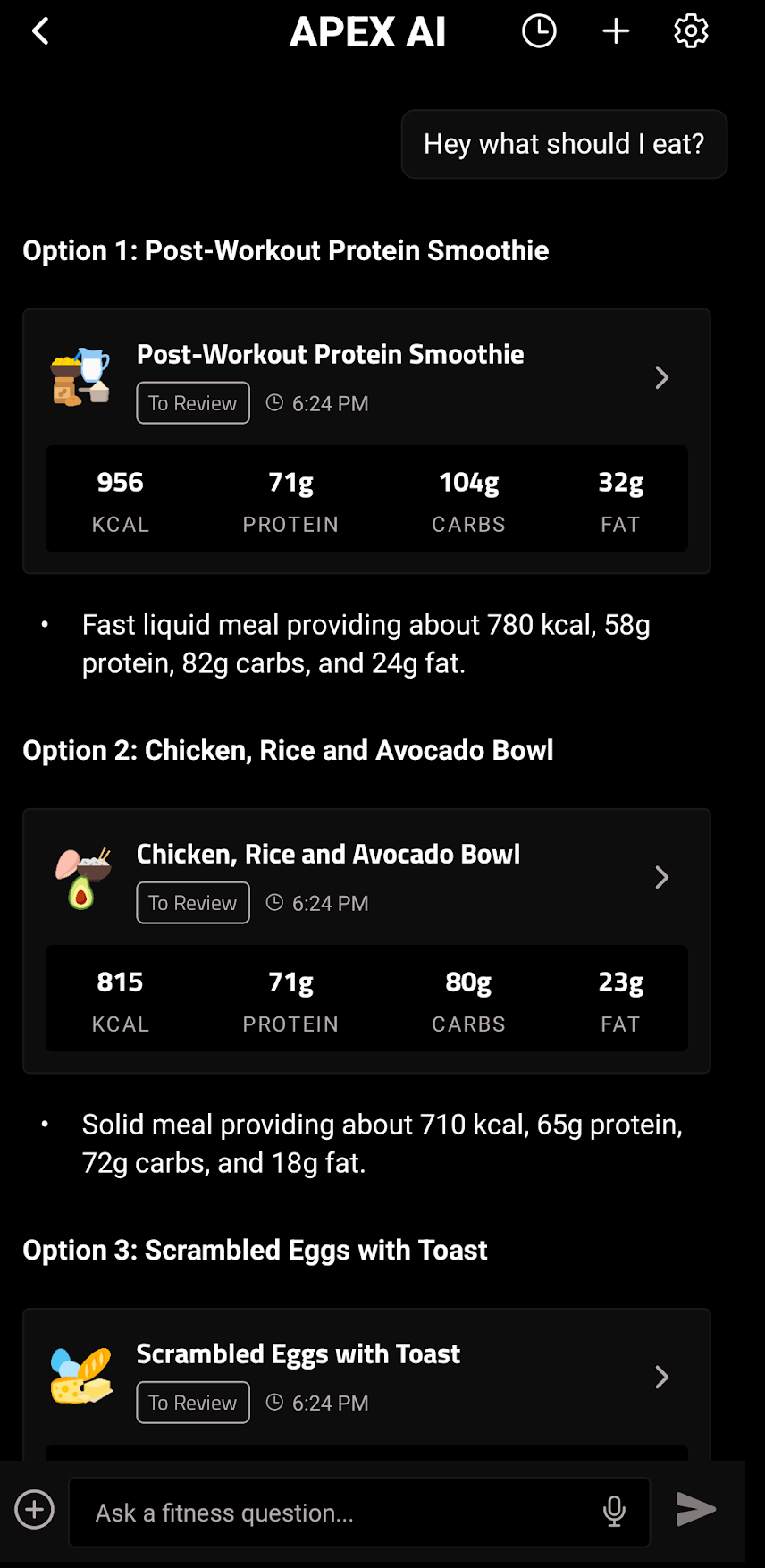
You simply ask "What should I eat?" or explicitly mention that it's for a post-workout meal and it will help you. APEX can use what workout you have planned that day and what you've logged or told it about your fitness (whether you slept well, whether you did cardio, whether you worked out fasted or late at night, etc.), so it can recommend a meal that fits. Tell it anything it's missing and check the portions.
Want to test it? It's free for the first month... check it out.
Post-workout meal FAQs
Is a protein shake enough after a workout?
Yes. It can provide enough protein to help with MPS and offer some carbs, depending on what you mix into it. But by itself, it may not cover what you need from a full meal. Unless some carbs (oats, fruits, honey, etc.) are added, it may not be the ideal post-workout meal by itself.
Can I eat carbs after a workout while losing fat?
Yes. Many types of fast and slow carbs can fit well within calorie deficits. It's still important to control the type of carbs, and more importantly, how much. Eating too much bread or any other food can still break a deficit. Processing alone doesn't decide that.
What if dinner or lunch is close (1-2hrs from training)?
For these situations is usually a better idea to wait. If you ate protein before training, there's usually no need to rush another meal within minutes. This may change if you trained while fasted or did really long cardio sessions. Otherwise, you can always wait a bit longer to eat your dinner or lunch instead of a custom post-workout meal.
What can I eat after a workout without dairy?
Chicken, fish, steak, tofu, eggs, and pretty much most types of carbs are excellent choices for post-workout meals. You don't need to eat something with milk or whey protein to make your post-workout meal worth it. And in case you still want a convenient shake, there are tons of vegan and no-dairy protein powders (like soy, pea, hemp, and rice protein) you can use.
Must I eat immediately after training?
No. There's no single timeframe that applies to everyone. As long as the next meal contains enough protein and carbs, you should be good. Be aware though: long cardio sessions and fasted training may require food closer to training to help with recovery, especially if another session is coming soon.
Sources
The scientific sources in this article were checked November 6, 2026. The meals are examples, not guidelines or medical recommendations.
- Macnaughton LS et al. The response of muscle protein synthesis following whole-body resistance exercise is greater following 40 g than 20 g of ingested whey protein. Physiological Reports, 2016. Primary acute protein-dose trial.
- Schoenfeld BJ et al. Pre- versus post-exercise protein intake has similar effects on muscular adaptations. PeerJ, 2017. Primary ten-week protein-timing trial.
- Morton RW et al. A systematic review, meta-analysis and meta-regression of the effect of protein supplementation on resistance training-induced gains in muscle mass and strength in healthy adults. British Journal of Sports Medicine, 2018. Protein and resistance-training synthesis.
- Kerksick CM et al. International society of sports nutrition position stand: nutrient timing. Journal of the International Society of Sports Nutrition, 2017. Nutrient-timing position stand.
- Aragon AA et al. International society of sports nutrition position stand: diets and body composition. Journal of the International Society of Sports Nutrition, 2017. Diet and body-composition position stand.
- U.S. Department of Agriculture, Agricultural Research Service. FoodData Central. Reference calculations use SR Legacy records 171477 (chicken), 168878 (rice), 170379 (broccoli), 170894 (yogurt), 173904 (oats), 173944 (banana), 171287 (eggs), 172688 (bread), and 172475 (tofu). Multiply the per-100g values by the portion in grams divided by 100, then add the ingredients and round.
- StarKist. Chunk Light Tuna in Water 25% Less Sodium nutrition label.