· By APEX
When to bulk, cut, maintain, or recomp
Here's everything you need to decide between bulking, cutting, maintaining or recomping.
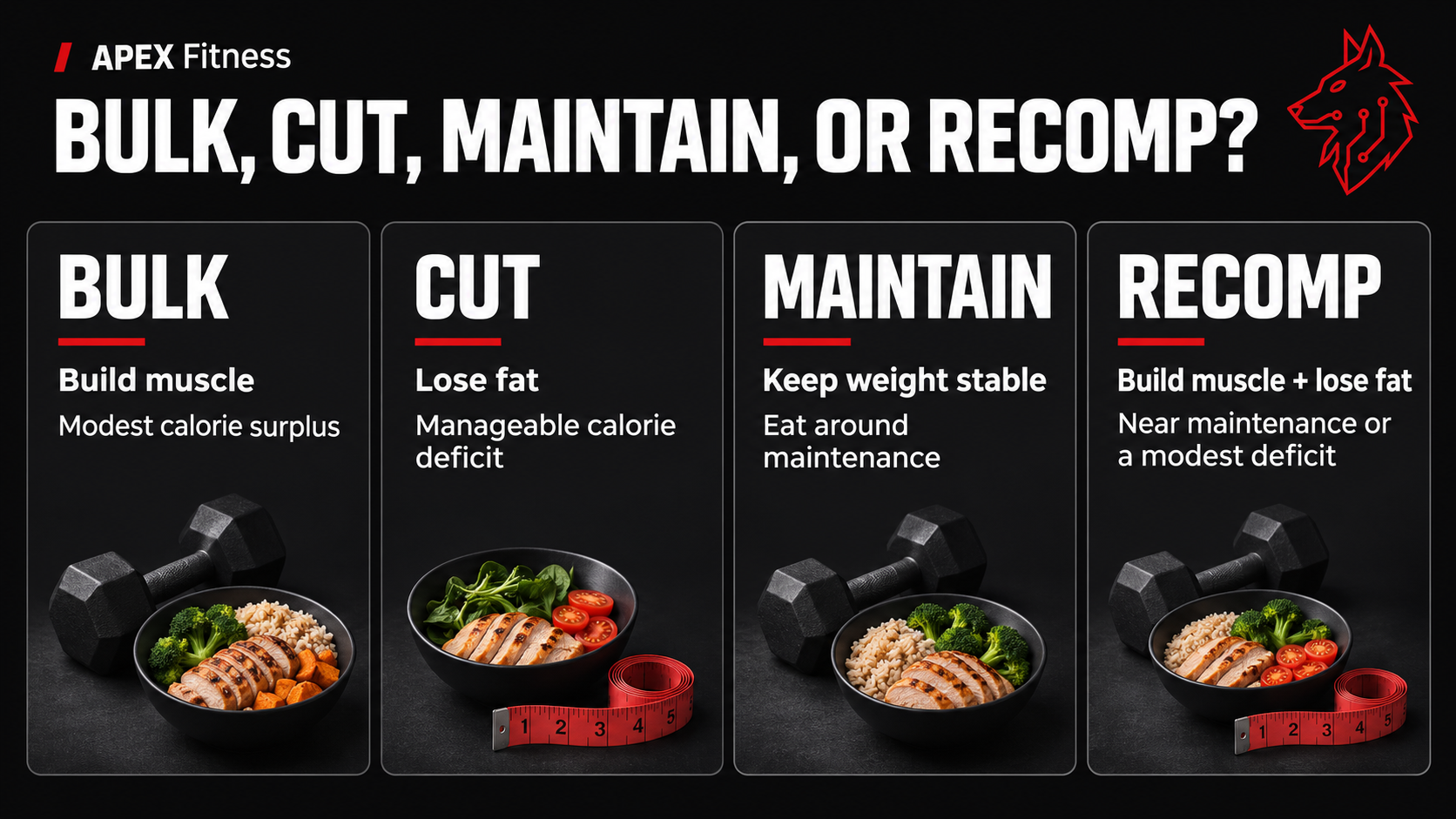
The way to find out is based on a simple decision matrix, starting from your goals:
Is your priority building muscle, losing fat, staying active, maintain a stable weight, or want to build muscle while losing fat?
A bulk is eating on a surplus. Usually for gaining weight and building muscle in the process. A large surplus will make you gain more fat and less muscle while increasing your weight faster. A small surplus may help gain muscle without adding much fat.
A cut requires you to be on a caloric deficit, which reduces your fat and lowers your weight. A light or moderate one is usually recommended. An aggressive cut may burn more muscle.
If you're not aiming for a particularly quick change in weight or growth, then go for maintenance. It's also the right choice if you're transitioning from an aggressive bulk or cut.
And if you what you want is to build muscle while losing fat, then you should consider a recomp. It doesn't work for everyone but can be a counterintuively great choice for anyone with high body fat and/or less training experience.
If you don't want to find out manually, then check our free tool above, Otherwise, if you want to see how APEX helps you decide, check our guide below:
What bulk, cut, and maintain, and recomp actually mean
| Phase | What you do with food | What you're aiming for |
|---|---|---|
| Bulk | Eat slightly above maintenance. | Gradually gain weight while training to build muscle. |
| Cut | Eat below maintenance. | Lose fat while working to keep your muscle and strength. |
| Maintain | Eat around maintenance. | Keep your weight broadly stable while you train and reassess. |
| Recomp | Eat slightly below maintenance. | Lose fat while trying to gain muscle. |
IMPORTANT: Bulking doesn't mean eating as much as possible. Cutting doesn't mean letting go of carbs. And maintenance doesn't mean you will stop working out.
Below, we explain exactly when you should use each.
When to bulk?
Want to build some muscle but don't mind your weight (and fat) going up? Then go for a bulk.
The best time to start builking is just after a cut or maintenance. It also works for beginners with lower body fats (under 15%) and little muscle foundation.
Having said that, bulking is not for everyone. It requires proper planning and can easily become too much of a surplus in which it adds more fat than muscle.
That's why a moderate bulk is usually the right choice. It varies, but a 200 to 300 calorie surplus tends to work for most people.
In some cases the bulk may also be small enough to help build muscle without adding significant fat. This is a light or small bulk, typically useful for long-term plans of growing while keeping the waist size stable.
To find out the right level of calorie surplus for the bulk, you may want to look at your average weight over the last few weeks, the current waist easurements, and the actual lifting progress (how well your lifts are progressing). If weight and waist seem to be increasing or there seems to be higher fat gains in the most stubborn areas (waist, stomach, and sides) then review the size of the bulk.
Bulks are better for people below 25% body fat with active lifestyles and low BMI (under 20). High body-fat, sedentary people with high BMI should avoid bulking altogether.
NOTE: A bulk is not an excuse to stop paying attention to what you eat. It may allow higher calorie intake every day, which could help relax food choices. But that doesn't mean that anything goes. If anything, it's even more important to pay attention, because it can be pretty easy to overeat.
When to cut?
Want to lose fat, reduce your waist measurements or simply lower your weight? Then go for a cut.
It's the simple process of lowering your calorie intake below maintenance levels. As long as you keep it sustainable a calorie deficit drives fat loss without losing much muscle.
While the purpose is to lower down your calories, your lifting should stay stable. For aggressive cuts (only in certain scenarios), a mild reduction in lifting volume may help. But for most people, if they want to keep muscle (or possibly build some), they need to keep their training volume high.
Aggressive cuts (rushing to lose weight or fat too quickly), can burn more muscle than expected. Slower cuts produce better lean-mass results without affecting performance. Even more important, slow to moderate cuts tend to be more sustainable over time and produce little to no over-compesation (when lifters end up eating on a surplus from stress).
A cut (calorie deficit), is better for people above 15% body fat and active lifestyles. People with very high calorie expenditure (athletes and super-active individuals) should only cut when going for specific goals (meeting a weight limit, for example).
NOTE: Aggressive cuts may lower stamina, endurance, and cause persistent fatigue when done wrong. Under-fueling for training can cause health and performance issues (in both men and women. Persistent fatigue, recurring injuries or menstrual changes deserve individual assessment. If any sign of lower capacity shows up while on a cut, feel free to stop. Eating at maintenance tends to be a better choice in that case.
When to maintain?
When you don't have a specific desire to change your body, then you go for maintenance.
This means you are comfortable with your weight and current body composition. Sometimes it's just about staying active or getting stronger over time without causing aggressive composition changes.
For bodybuilders and those who take it more seriously, maintenance can also be a transition period after an aggresive cut or bulk. While figuring out what to do afterward, maintenance helps keep the weight, body fat, and muscle from the previous plans, while staying active and maintaining or increasing training volume.
This is an excellent period for people who still have things to work on. It allows for improving lifts and having a more consistent training schedule. And if what you want is to work on a more reliable level of meal quality, then maintenance also helps by keeping your nutrition sustainable.
Let's say you want to improve how much weight you lift on your squats. You're happy with your current size and you don't want to follow an aggressive diet at the moment. In that case, eating at maintenance calories would be perfect, because it gives you enough fuel to keep your strength going up while preventing you from gaining too much weight or fat in the process.
To get a maintenance calorie target , you should eat what you burn in a day. That is, you need to calculate your daily expenditure (age, height, weight, level of activity) and then eat around that amount of calories every day.
NOTE: Maintenance calories are supposed to be enough to sustain your daily activities. If you are experiencing sleep problems, lack of energy, or inability to eat enough, then you should reassess. The same happens if you're eating at "maintenance" but you start gaining weight and fat within weeks. That usually means you're actually eating more than you should.
When to recomp?
Want to build muscle but also lower your body fat? It's entirely posible and it's called a recomp.
A recomp isn't exactly a bulk or a cut. And it isn't certainly maintenance either.
The amount of calories to eat during a recomp depends on many things. But it's usually either a small deficit or near maintenance calories.
What a recomp aims for is to make sure you keep building muscle while some of your fat is burned. It's a slow process, and not everyone can do it.
First off, it requires consistent resistance training. Without high training volume, a recomp becomes less useful because not enough muscle will be built. At the same time, it demands high amounts of protein.
The problem is that muscle gain tends to be pretty slow for people who are already high muscularity. And it also makes fat loss a lot slower for people whose body fat is already low (around 15% or lower).
As long as you're not eating on a surplus, you should be okay. Gaining lean mass while losing fat is totally possible as long as training intensity and a high-protein diet are in place..
The difficult part about a recomp is how much discipline it requires. It will force you to log all your meals, keep training hard, and stay consistent with your sleep (so you don't end up eating to compensate). More importantly, you need to eat enough protein to keep supporting growth while on a small deficit.
APEX's macro calculator can help you set the right recomp targets accordingly.
That's why it's an appealing choice for people returning from a hiatus, beginners who have little training experience, or those who may have experience but are currently high body fat (above 20%) with limited muscularity. Beginners and people who haven't worked out in a while tend to get the fastest results.
NOTE: recomp is not a stage to stop measuring your body, not training hard enough, or leaving nutrition on the backseat. If anything, it requires more discipline and consistency in every area than any other stage.
How to choose when you want everything
Let's be honest, everyone wants to build more muscle and lose fat. But while recomp is an excellent choice for some people, it's not really a good idea for most.
That's why it's usually a smart to learn how to prioritize depending on where you're standing.
If you want to build muscle and your body fat is average (15% to 22.5%) and you don't mind gaining a bit more, then you should have no problem going on a bulk.
If your focus is to lose fat, then you should be okay with losing a bit of muscle. For that, you must go on a cut.
If you want to pursue both muscle and fat loss and you're coming from a hiatus or have high body fat with little training experience, then a recomp is usually a good choice.
If none of these sound like you, then a maintenance phase wouldn't hurt while you get clearer goals.
Either way, you don't need an exact body-fat percentage to make a choice. Estimates can add context and help you decide, but it's your preferences, training consistency, and experience that matter the most.
What may help is knowing your calorie target according to your goals. For that, you can use the calorie calculator to help you at first.


Bulk, cut, maintain, and recomp FAQ
Should I bulk or cut if I'm skinny fat?
A label shouldn't choose your goal. Being "skinny fat" is not a starting point that should decide whether you eat on a surplus or a cut. What matters is your goal: do you want to build muscle and lose fat at the same time? Then try a recomp. Don't care about gaining some fat while you maximize growth? Then go for a bulk. And if you just prefer to cut down on your body fat, a cut is your best bet.
Is recomp the same as maintenance?
No. While maintenance keeps your weight and body composition stable, a recomp will force you to lose fat while building muscle. A recomp phase usually requires more protein with fewer calories than a typical maintenance phase.
Does being a beginner mean I should recomp?
No. Being a beginner makes a recomp easier if you have high body fat and/or low muscularity. But it doesn't mean you should go for that. Usually the best phase for you is what matches your actual goals better. Experience just sets expectations for training, but your nutrition should be more goal-based.
Should women choose differently?
No. All types of nutrition plans, for both men and women, follow the same priorities: individual calorie and recovery needs, medical factors and overall needs. Gender doesn't change what stage you choose. Although APEX makes sure to pick the right phase according to your individuals preferences.
What is the bulk or cut tool for?
The tool helps you choose a priority for your next nutrition plan. It won't prescribe calories, help you find out your macros or help you get a body-fat percentage.
What are important caveats to consider?
The tool won't assign you into a cutting phase if your BMI is below 18.5. At the same time, if your BMI is above 30, it will not offer a bulking phase. Specific situations like pregnancy or breastfeeding, people with eating disorder history or general dieting conditions that require specialized treatment won't be taken into account, so proceed with care.
Sources
- Helms et al. Energy surpluses, strength, muscle, and skinfold thickness. Sports Medicine - Open, 2023.
- Murphy and Koehler. Energy deficiency and resistance-training gains. Scandinavian Journal of Medicine & Science in Sports, 2022.
- Longland et al. Dietary protein during an energy deficit and intense exercise. American Journal of Clinical Nutrition, 2016.
- Mountjoy et al. IOC consensus on Relative Energy Deficiency in Sport. British Journal of Sports Medicine, 2023.
- Garthe et al. Two weight-loss rates, body composition, and performance in athletes. International Journal of Sport Nutrition and Exercise Metabolism, 2011.
- Morton et al. Protein supplementation and resistance-training gains. British Journal of Sports Medicine, 2018.
- Aragon et al. ISSN position stand on diets and body composition. Journal of the International Society of Sports Nutrition, 2017.