· By APEX
Body Recomposition: How to Lose Fat and Build Muscle at the Same Time
Can you really build muscle while losing fat? This is what a body recomp looks like...
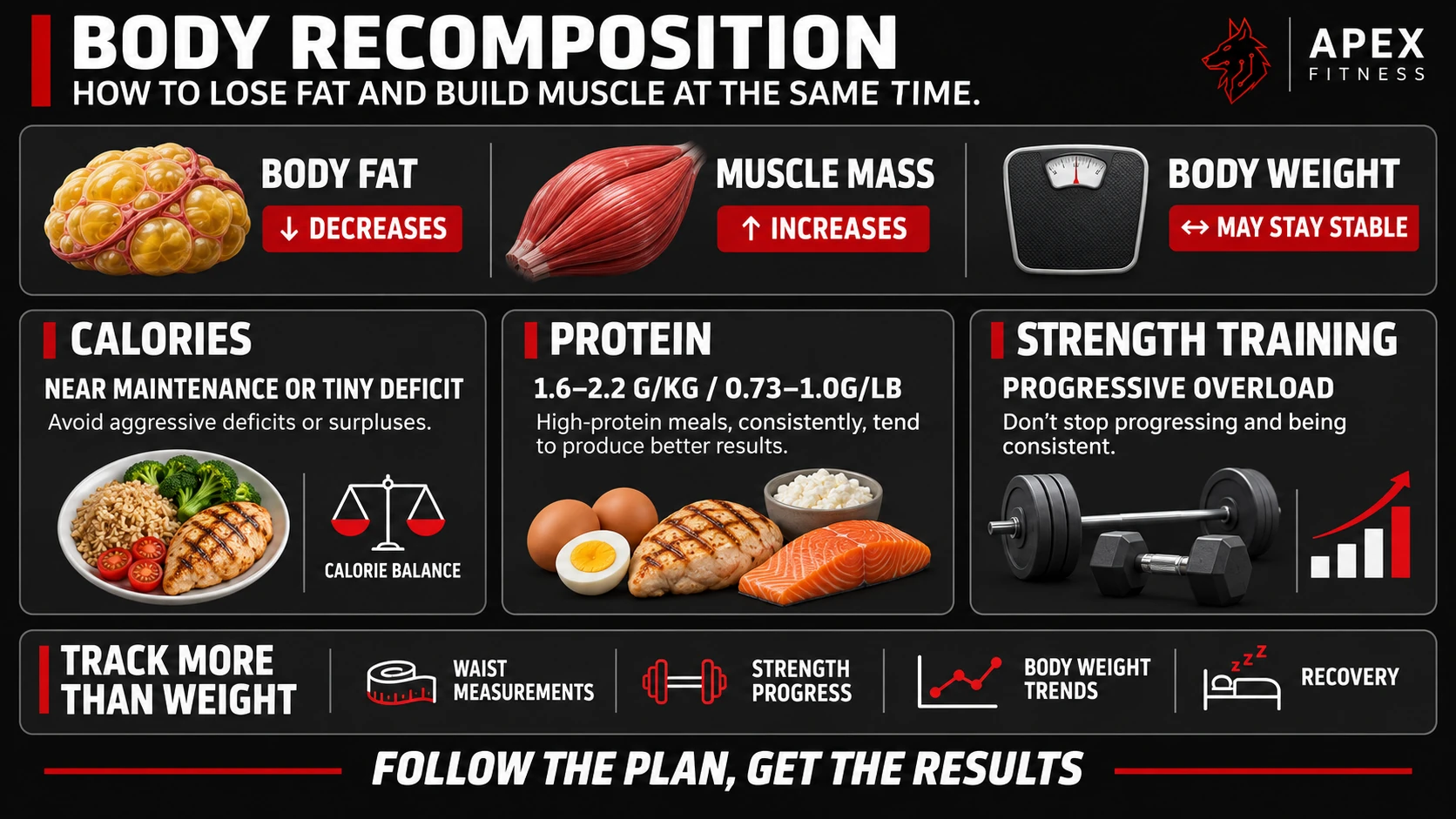
If you want to lose fat and build muscle in the same phase, you're in for a treat.
A lot of people would say it's a fad, that a body recomposition doesn't work, and that you'd be better off following a bulk or cut phase instead.
That's not true.
A body recomposition is one of the best ways to actually change how your body looks without having to go into aggressive surpluses or deficits.
But there's something true about what people say: a body recomp can be a bit harder for some people.
The tricky part is finding out where you are fitness-wise and whether a recomp is the perfect plan for you.
If it fits your goals and profile, it may help you not only burn fat and build muscle, but also build a strong lifting foundation in the process.
Here's how to set up your training, your nutrition, and how to make progress while on a body recomp plan:
What body recomposition means
It's as simple as it sounds: reduce fat while adding muscle.
The difference between a recomp and a cut is the main goal. A cut prioritizes losing fat while preserving muscle. A body recomp aims to build muscle while reducing fat. A large deficit can make gaining lean mass harder, even with lifting.
Similarly, a bulk phase prioritizes muscle gain, usually with a calorie surplus. Some of the weight gained may be fat. A body recomp aims to reduce fat while building muscle, but neither change is guaranteed.
Sure enough, a body recomp may be SLOWER at both building muscle and losing fat than a bulking or a cutting phase independently. You can perform a recomp for a long time if the plan stays useful and sustainable. Bulking and cutting can also last for months, with the length depending on your starting point, progress, and recovery.
Does this sound like a fad? It's not.
Losing fat while increasing lean mass can happen together, even during a substantial calorie deficit under controlled conditions.
The trial testing this asked young men to eat lots of protein and perform lifting and high-intensity interval training six days a week, with about 40% fewer calories than their estimated needs. The higher-protein group lost fat and increased measured lean mass... IN JUST FOUR WEEKS. That was a specific, demanding protocol, not a recommended deficit or a deadline for your results. Lean mass includes more than muscle, so that increase doesn't establish how much actual muscle grew.
But there's a caveat: a body recomp is not for everyone...
Who is body recomposition realistic for?
This is what matters most and where you should pay the most attention.
Sure, a body recomp can do wonders. But not everyone will get the same results, and not at the same pace.
Here's what you can expect depending on who you are:
-
High body-fat with little lifting experience: a reasonable choice. You may be able to lose fat and build muscle, with tons of room to improve your lifting. People who are new to training, coming back from a hiatus or haven't taken the time to do it seriously often have more room to improve. That doesn't guarantee a recomp.
-
High body-fat with high muscularity: an option. If you've trained for a while but seem unable to commit to a traditional cutting phase or aggressive deficit, then you may find a body recomp useful. Although, it will still require consistency, and a cut doesn't have to mean an aggressive deficit.
-
Low body-fat with little experience: depends on the goal. You may be able to build muscle without much change in body fat. Your lack of lifting experience leaves room to improve. Although, if you're already very lean, losing more fat may not be appropriate, and a muscle-gain phase may be a better choice.
-
Low body-fat with tons of experience: questionable choice. You may still benefit from a body recomp over a really long period. But your growth and fat loss can be limited if you're already lean and highly muscular. Having said that, if you don't have a specific goal to follow and just want to keep your body fat low and hopefully build muscle, it's still an option, with cautious expectations.
In short, here's what may make a body recomp worth considering:
- You have fat you'd like to lose
- You haven't trained consistently
- You have limited lifting experience
- You're coming back after months or years of not training
- You aren't following a specific phase (cut or bulk) at the moment
These are things to consider, not a score or a validated test. There's no required number of boxes to check, and a single body-fat percentage can't tell everyone whether a recomp is suitable.
But if you're already lean and training consistently (for years), you may want to set more cautious expectations about a recomp.
In your case, as a lean and experienced lifter, you may prefer to focus on doing a bulk or cut independently. Check our bulk, cut, or recomp guide if you still don't know what to do.
Once you find out whether a recomp is ideal for you, it's time to start setting up the details...
Setting up calories for a recomp
The recommended configuration starts NEAR your estimated maintenance. A modest deficit is an option if losing fat is the higher priority and you can still recover well.
The more training volume you're doing every week, the more attention you need to pay to recovery. Training three or fewer times a week doesn't automatically make a deficit the better choice. Your goal, intake, and recovery matter too.
Either way, avoid eating too far into a deficit. A large cut can actually harm your muscle-building potential (even if you're training hard enough). A surplus may suit a muscle-gain phase, but it doesn't promise simultaneous fat loss.
Don't know what your maintenance calories are? Try our calorie calculator to estimate it. Your maintenance calories are your starting point, and will eventually change based on your actual energy intake, level of activity, and response to the recomp as you go. With APEX, logging your meals and tracking your workouts will make it easier to know what to change eventually to make the recomp more effectively.
Here's how to decide more easily:
-
Is your higher priority losing fat? Then consider a calorie range modestly UNDER your estimated maintenance.
-
Is your priority gaining muscle? Then start close to maintenance. You don't have to force a deficit if it makes training and recovery worse.
-
Want to improve your lifts? Then start around maintenance and check whether your food intake supports training and recovery.
-
Are you returning from a long training hiatus? Start around maintenance, and reassess within a couple of weeks.
Either way, when we say "maintenance", we refer to an estimated intake based on your profile (age, weight, height, training status, and general activity). Your actual maintenance may change over time. Consistent food and workout records, alongside weight trends, help you refine the estimate.
Set your macros: protein first, then fats, the rest is carbs
You can start with a protein target within 1.6 to 2.2 grams of protein per kg, or about 0.73 to 1g per pound of bodyweight, per day. The upper end isn't required for everyone who wants to build muscle.
Average additional gains in fat-free mass levelled off around 1.6 g/kg/day in resistance-training studies without calorie restriction. The uncertainty around that estimate extended to about 2.2 g/kg/day. During a substantial calorie deficit, 1.6 and 2.4 g/kg/day both helped preserve more fat-free mass than 0.8 g/kg/day. That doesn't establish 2.4 g/kg as better than 1.6 for everyone, and fat-free mass isn't identical to muscle.
For an 80kg / 176lbs adult, the arithmetic is:
| Metric Calc (weight x protein) | Imperial Calc (weight x protein) | Daily protein |
|---|---|---|
| 80 kg × 1.6g/kg | 176 lbs × about 0.73 g/lb | About 128g |
| 80 kg × 2.2g/kg | 176 lbs × about 1 g/lb | About 176g |
This range is an example. The pound values are rounded. You can get a starting estimate at our macro calculator.
Leaner athletes and people with substantial body fat and little muscularity may need different approaches. Do not push the number higher without first re-assessing.
Now, eating lots of protein every day can be tough. This is especially true if you're going for the higher range. Here's how to make eating that amount of protein doable:
-
Protein on every meal: count how many meals you want to eat every day. Then divide the protein amount by the number of meals. The result is an average to aim for, not a requirement for every meal. Example: 176g / 5 meals = 35.2g of protein per meal.
-
Use whole carbs: rice, potatoes, oats, fruits, vegetables and legumes can all fit. Keep room for your protein sources too. Processing alone doesn't tell you whether a food fits your calorie or protein target.
-
Careful with fats: a recomp doesn't mean you're going to ignore fats.
Put a protein source into your regular meals. Then use the remaining calories for carbs and fat in a way you enjoy and can repeat. Rice, potatoes, oats, fruit, vegetables, legumes, and the fats you cook with can all fit. You don't need a fixed macro percentage or a protein shake to call it a recomp diet.
Use the macro calculator to set protein, carb, and fat targets. Check how those targets fit your appetite and training instead of treating every gram as a pass-or-fail test.
How to make progress during a recomp
A recomp is explicitly focused on improving your body composition, with training performance helping you judge how the plan is going.
Here's what we recommend doing when you're starting:
-
Pick a starting intake that matches your profile (use our calorie calculator to find out first).
-
Log all your foods (solids, liquids, oils, sauces, etc.), then make sure to stay within the given range. APEX helps you log with pictures if that makes it easier.
-
Check your progress weekly or every two weeks. Weight, waist measurements, training performance and recovery markers. Together, these help you judge whether you're on the right path, but they don't prove exact muscle gain.
-
If your measurements, training, and recovery are moving in the right direction, then keep going. If not, make small adjustments where necessary. Don't cut or add more calories just because, make sure there's a consistent trend to address.
Two weeks can be a useful first check on adherence and recovery, but it's not a deadline for visible body recomposition. Leaner and more experienced individuals may need longer to detect small changes.
Either way, don't get impatient and make desperate changes. Give it some time. Short-term changes in water and food weight can make the trend harder to see.
Build a repeatable lifting plan for every week
One of the important part of a body recomp is a HARD training plan. But it shouldn't be too hard that you can't sustain it over a long period. A recomp requires you to do the same thing over and over for enough time to see results, especially if you're already lean and muscular.
Once you have a sustainable workout plan, it's all about proper progression. That's what matters most. Adding reps or weight to your lifts can help you move forward.
If you already have a productive workout plan, keep it. You don't have to re-do your workouts just because you're now doing a recomp. However, if it's a temporary plan for a specific goal, then feel free to reassess it.
Whatever you go for, make sure to log all your workouts for more consistent progress. APEX helps you with that, while asking you to keep a record of how hard each set feels, and adapting your routines to your actual performance over time.
Now, if what you need is an example workout plan for a body recomp, here's one you can re-use (this is a standard, full-body routine for a regular lifter, not a prescription):
| Day | Example session |
|---|---|
| Monday | Full body A: squat or leg press, chest press, row, leg curl |
| Wednesday | Full body B: hip hinge, overhead press, pulldown, split squat |
| Friday | Repeat A, then start with B the following week |
| Other days | Rest, walking, or manageable cardio around your recovery |
Regardless of what you go for, make sure it's the right training volume for your needs.
In other words, choose exercises that you can perform every week for a long time and make every working set challenging enough while performing the exercises properly. Failure every set is not necessary for progress. Stopping close to failure can produce similar muscle growth with less fatigue. That doesn't mean it removes all fatigue or injury risk.
If you want to know how to make proper progress, check our progressive-overload guide.
Don't ignore cardio and recovery
A muscle-building program with a recomp nutrition plan is also compatible with cardio. In fact, combining cardio exercise and lifting generally offers improvements in muscle size and maximal strength. Of course, the amount of cardio and how separate from your lifting it is still matters, especially when you're also eating less.
But as long as you keep your activity at a level you can still recover from, there's not much to worry about. If hard runs around leg days hurt your lifting or recovery, move them or reduce them.
And in case cardio starts making your lifting worse, then feel free to reassess (separate from lifting days or reduce how much you're doing).
In either case, don't forget to sleep properly. Restricted sleep during a calorie deficit can reduce fat loss and increase fat-free mass loss. That result came from a small, short trial. It doesn't tell us what one bad night will do, but sleep is worth checking when recovery gets worse.
For people whose performance and recovery get worse after starting a recomp and cardio, it's worth rethinking the approach. Depending on the cause, that may mean adding calories to accommodate cardio expenditure, reducing the amount of aerobic exercise, or addressing sleep and other recovery problems.
Track your progress
A recomp may require more consistent tracking and logging of your meals. It also forces you to pay a bit more attention to changes on your body.
We recommend comparing different parts of your body as you go. Start with measurements and weight. Then consider performance improvements. Recovery trends also matter. And lastly, optional progress photos can help you compare appearance, but they can't confirm exact fat loss or muscle gain.
Here's how you can use them:
| What to track | How to make it useful | What it can't prove |
|---|---|---|
| Body weight (if relevant) | Compare averages from daily weigh-ins or several check-ins (weekly or bi-weekly) | How much of the difference between days is fat, muscle, water, or food. |
| Waist | Use the same spot, posture, tape tension, and time of day. Reduced numbers may point at progress. | Fat loss or muscle gain. |
| Body photo scans | Keep the same lighting, distance, clothing, and posture across check-ins. | Your precise body-fat percentage or a reliable short-term composition change. |
| Workout performance | Compare loads, reps, and reported difficulty on repeated exercises. | More weight doesn't necessarily mean more muscle. |
| Recovery trends | Quality of reported sleep quality, mood, and overall consistency. | Medical diagnosis or source of problems (if any). |
For these comparisons, consistent records help: meals, workouts (sets, weights, etc.), and checks on sleep, weight (optional), and how well you feel overall. You don't need a perfect record of EVERYTHING to make progress.
Even a DXA scan's lean-mass reading can change with meals and daily activity. Water and glycogen also affect lean-mass readings. Keep measurement conditions consistent and don't treat a short-term change as confirmed muscle growth.
APEX lets you track meals and workouts together, so you can review both in the same place. Whether you're doing a recomp or any other type of nutrition plan, those records help you decide what to adjust.


When to keep going and when to adjust
If you're tracking consistently, then you should consider checking in every 2 to 4 weeks during a recomp (this depends on the lifter profile). That's a practical review schedule, not a proven deadline for muscle growth. Worsening recovery deserves attention sooner.
Here's what to look for:
| What to notice | Check first | What to do next |
|---|---|---|
| Waist is trending down and performance holds or improves | Measurement consistency and recovery | Keep going. Those are useful signs of progress, but they don't prove muscle gain. |
| Weight is flat and there's no other signal | Incomplete logs or check-in consistency (same time of day, proper measuring, etc.) | Collect clearer data before adjusting. |
| Weight and waist keep rising | Food portions, total daily intake or reduced activity | Reassess caloric intake. Make sure you're following the plan. If yes, change. If not, fix adherence. |
| Weight falls but performance and recovery worsen | Food intake, sleep, training fatigue, illness, or injury | Change nutrition or workout plan. If recently added cardio, reduce or eliminate. |
| Several measures stay unchanged despite consistent execution | Training effort and progression, food records, and your main goal | Change inputs and revisit goal(s). Don't change everything at the same time. |
| Persistent fatigue or repeated injuries | Your health and recovery context | Get qualified assessment rather than pushing harder. |
In these cases, check adherence, consistency, and logging before making changes. But don't assume they explain everything. Training load, food intake, sleep, and health can also need attention.
If you'd rather focus on losing fat or building muscle separately, then learn how to pick first. You can change direction without treating your inability to do a recomp phase as a failure.
How long does body recomposition take?
There's no specific time to expect changes at. Visible changes can take months, and small changes may be difficult to measure. Experienced individuals with low body fat may need more time to detect progress.
In either case, consistency while eating and training makes it easier to judge whether your plan is working. APEX can help you keep those records together.
If you do those consistently, then you'll have better information to work from. But if you keep changing plans before you can assess them, then it becomes harder to know what needs adjusting. Tracking itself doesn't guarantee results.
Body recomposition FAQs
Can you recomp at maintenance calories?
Yes, you can start around your estimated maintenance, especially while starting. But an estimate doesn't establish your true energy balance. And depending on your goal and where you're starting, starting at maintenance may be a great idea or a bad one.
Can experienced lifters recomp?
Yes. But don't expect quick changes if you're already lean and training consistently. If you are disciplined and patient enough to wait for results to arrive, a recomp can be an excellent idea. But if you'd rather get results quickly, feel free to follow a cutting or bulking phase instead.
What if my weight stays the same?
Nothing. A recomp (especially in leaner and more experienced individuals), may not change your weight at all. Other changes like waist measurements, lifting performance, and recovery are more important. Weight tells you little about whether a recomp is working or not.
How much protein do I need for body recomposition?
Aim for 1.6 to 2.2g/kg, or about 0.73 to 1g/lb, per day as a starting range. Higher isn't automatically better. Your actual context, starting body composition, and individual needs may change this.
Do I need cardio for body recomposition?
No. Although adding cardio to increase your activity expenditure is not a bad idea. Lifting is still more important than cardio during a recomp.
Sources
Research behind this guide
- Longland TM et al. (2016). Higher compared with lower dietary protein during an energy deficit combined with intense exercise promotes greater lean mass gain and fat mass loss. American Journal of Clinical Nutrition, 103(3), 738-746.
- Murphy C and Koehler K. (2022). Energy deficiency impairs resistance training gains in lean mass but not strength. Scandinavian Journal of Medicine & Science in Sports, 32(1), 125-137.
- Morton RW et al. (2018). A systematic review, meta-analysis and meta-regression of the effect of protein supplementation on resistance training-induced gains in muscle mass and strength in healthy adults. British Journal of Sports Medicine, 52(6), 376-384.
- Pasiakos SM et al. (2013). Effects of high-protein diets on fat-free mass and muscle protein synthesis following weight loss. FASEB Journal, 27(9), 3837-3847.
- Plotkin D et al. (2022). Progressive overload without progressing load? The effects of load or repetition progression on muscular adaptations. PeerJ, 10, e14142.
- Refalo MC et al. (2024). Similar muscle hypertrophy following eight weeks of resistance training to momentary muscular failure or with repetitions-in-reserve in resistance-trained individuals. Journal of Sports Sciences, 42(1), 85-101.
- Nana A et al. (2012). Effects of daily activities on dual-energy X-ray absorptiometry measurements of body composition in active people. Medicine & Science in Sports & Exercise, 44(1), 180-189.
- Bone JL et al. (2017). Manipulation of Muscle Creatine and Glycogen Changes Dual X-ray Absorptiometry Estimates of Body Composition. Medicine & Science in Sports & Exercise, 49(5), 1029-1035.
- Schumann M et al. (2022). Compatibility of concurrent aerobic and strength training for skeletal muscle size and function. Sports Medicine, 52, 601-612.
- Nedeltcheva AV et al. (2010). Insufficient sleep undermines dietary efforts to reduce adiposity. Annals of Internal Medicine, 153(7), 435-441.